When "Manage It Like That" Becomes the System
There's a phrase that lives in almost every hospital, said not with alarm, but with the quiet resignation of people who've learned to keep things moving no matter what: "Just manage it like that."
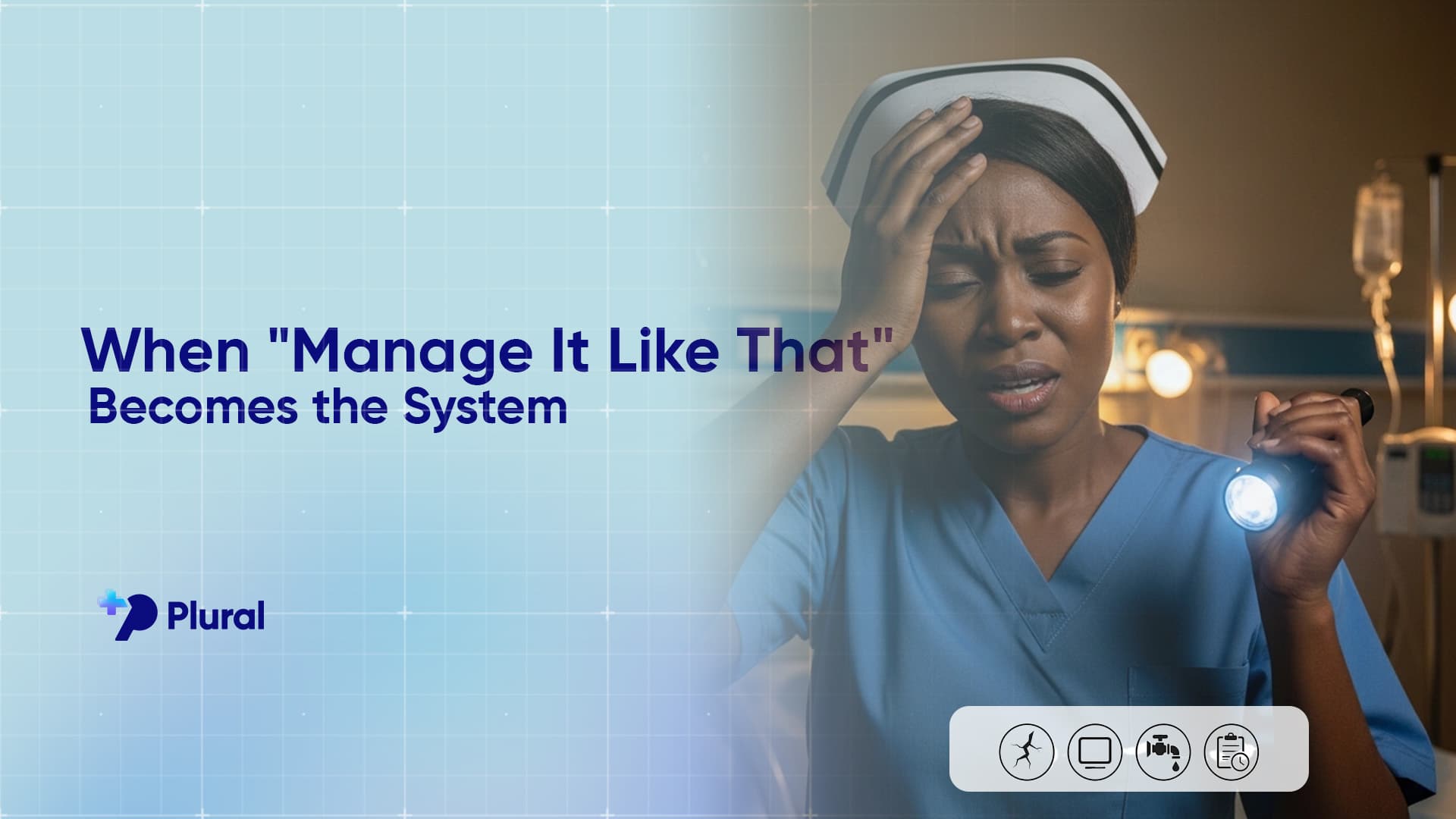
It starts small. A laptop that takes forever to load patient records; nobody replaces it, everyone learns to open it ten minutes early. A power cut that knocks out documentation mid-shift; staff stop being surprised and start keeping paper backups out of habit. None of these feels like a disaster. They feel like common sense.
But they're not as harmless as they seem.
When the Patch Becomes the Plan
The moment a workaround stops being a temporary fix and starts being how things are done, something important has changed. Staff aren't deviating from the system anymore; they are the system. The exception has become the rule.
And nobody announces this change. It happens slowly, invisibly, through a hundred small adjustments that each make perfect sense in isolation. Processes get evaluated not by how well they should work, but by how well they can hold up under difficult conditions. That sounds like resilience. Over time, it quietly lowers the ceiling on what the system can even deliver.
The Layer Nobody Talks About
Underneath clinical capacity staffing levels, patient load, and service delivery is a less visible layer that shapes everything above it: the basic operational infrastructure that makes day-to-day work possible. Digital health tools sit directly on it.
When power is unstable and devices are unreliable, the impact follows a predictable pattern: staff maintain paper records alongside digital ones; documentation falls behind; different departments develop different habits. The digital tool becomes something people use when conditions allow, not something they depend on.
This isn't failure in the dramatic sense. No alarms go off. But the system is running at a fraction of what it was designed to deliver.
Why Digital Transformation Often Stalls in the Middle
A lot of healthcare digitisation conversations focus on the software question: which system to implement, how to train staff, and how to migrate data. What gets far less attention is the environment into which the software is being introduced.
You can deploy the most sophisticated Electronic Health Record on the market, but if the power goes out twice a week, if devices are too old to run it smoothly, then what you've actually deployed is a partial system layered on top of existing manual processes. The software didn't fail. But the environment wasn't ready, and nobody made that part of the plan.
Readiness Means More Than a Go-Live Date
Real readiness asks a grounded question: when a doctor needs to access a patient record at 11 pm, will the system be on? Will the device work? Will the power be stable? If the honest answer is "usually" or "we manage", that's not readiness. That's another workaround dressed up as a solution.
Addressing this means treating infrastructure not as a separate procurement issue, but as a core part of rolling out any digital system. Reliable devices and stable power at the point of care aren't extras. They're the floor that everything else stands on. For hospitals where upfront capital is the barrier, financing models that spread the cost over time can shift this from a budget obstacle to a phased operational upgrade.
A Closing Note
"Manage it like that" is not a sign of failure. In most cases, it's a sign of dedication that people find a way to deliver care despite conditions that make it harder than it needs to be.
But dedication was never meant to be a permanent substitute for functional systems. When the same workaround is required every single day, it's no longer just resilience. It's a signal.
The real opportunity in healthcare digitisation isn't just better software. It's creating the conditions where better software can actually do what it was designed to do because systems don't break dramatically at the point of design. More often, they break quietly at the point of use.
Upgrade your hospital. Pay flexibly.
Get onboarded on NeoEHR and access laptops + power infrastructure through our partnership with CredPal.
Packages starting from ₦452,067/month
Up to 12 months repayment | Fast approval | No stress
Learn more: https://wa.link/mse3oh
Terms and conditions apply
Tags:
About Okeh Collins
Contributing author at Plural Health, sharing insights on healthcare innovation and digital health solutions.