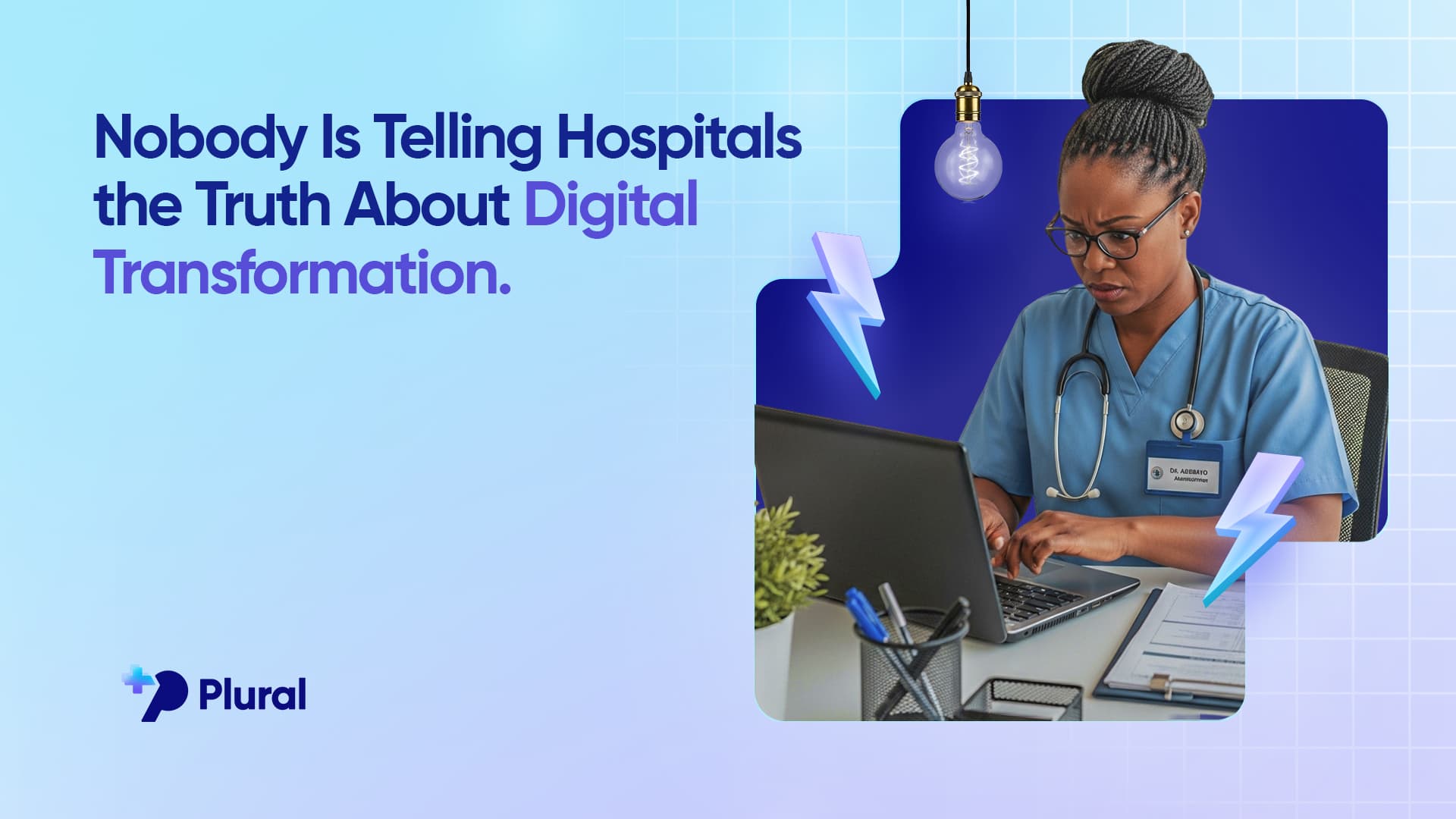
Nobody Is Telling Hospitals the Truth About Digital Transformation
We have sat in enough hospital offices to know what that conversation sounds like.
A vendor comes in. Talks about efficiency. Talks about paperless records. Talks about the future of healthcare. The hospital administrator nods, asks a few questions, and then nothing happens.
Not because they do not want change. But because the vendor never asked about the generator.
There is a particular phrase we have heard more times than we can count when speaking with healthcare facilities across Nigeria: "We want to go digital, but there is no light."
People say this almost apologetically, as if the power situation is a personal failure rather than a national reality. But it is not a personal failure. It is the most honest thing anyone in Nigerian healthcare can say, and it is the thing most technology conversations completely ignore.
We have built a narrative around digital health that sounds good in conference rooms and terrible in actual hospitals. "Eliminate paper records." "Improve patient outcomes." "Transform your operations." These are not wrong ideas. But they are incomplete ones.
Because a hospital in Rivers State or Kano does not just need software. It needs to know what happens to that software at 2am when NEPA, or whatever the electricity distribution company is called, takes the light and the generator is running low on diesel. It needs to know how the system behaves when internet connectivity drops mid-consultation. It needs to know whether its staff of twelve can actually afford twelve devices or whether two laptops and a shared tablet is the real starting point.
These are not edge cases. This is the operating environment.
The challenge with healthcare technology in Africa is that we keep solving the wrong problem.
We build for the ideal hospital. The one with stable power, reliable fibre, a dedicated IT person, and a procurement budget. That hospital exists. But it is not the majority. And chasing the majority while serving the minority is not transformation; it is decoration.
What has actually held hospitals back from going digital is rarely a lack of awareness. Administrators know the value of proper records management. They know that paper files get lost, that manual billing creates errors, and that tracking patient history across visits is a nightmare without a system. They know all of this.
What they do not have is a realistic path that accounts for where they actually are.
When you combine software licensing with hardware costs, power infrastructure, network setup, and staff training, the total figure can feel impossible for a facility already operating on thin margins. And so they postpone. And then postpone again. And the paper mountain keeps growing.
At Plural Health, we do not think the answer is to lower standards. We think the answer is to change the starting point.
There is a version of digital health adoption that begins with what a facility actually has, not what we wish it had. One that allows a hospital to start small and expand. One that is designed to function when connectivity is unstable. One that does not ask a hospital to choose between going digital and keeping the lights on.
This is the thinking that shaped NeoEHR not just as a hospital management system, but as a solution built around the actual environment Nigerian hospitals operate in every day.
But we also knew that good software alone would not move the needle. Because the question hospitals are really asking is not "is this technology good?" They already believe it is. The question is: "Can we afford to start right now, without disrupting everything else?"
That question deserved a real answer.
So we removed the biggest barrier to starting.
In partnership with CredPal, NeoEHR is now available on a Buy Now, Pay Later basis.
That means a hospital does not have to find the full setup cost before going digital. It does not have to wait for a budget cycle or a grant or a particularly good month. It can start today with a structured, manageable payment plan and begin recovering the operational value of the system while still paying for it.
No lump sum, no pressure to have everything figured out financially before you take the first step. Because that is what a realistic path actually looks like. Not a pitch, a promise or a structure that meets hospitals where they are.
Digital transformation in Nigerian healthcare is not waiting for hospitals to be convinced. Most of them are already convinced.
It is waiting on the industry to stop pretending that the conversation ends at the demo and start solving for what actually comes after it.
The hospitals still running paper systems are not behind. They are rational. They have looked at the full picture and concluded that the current options do not fit their situation.
That is not resistance. That is feedback.
The BNPL offer is our response to that feedback.
Apply Now: https://wa.link/mse3oh
If your facility has been waiting for a realistic way in, this is it. Get started today.
Tags:
About Collins okeh
Contributing author at Plural Health, sharing insights on healthcare innovation and digital health solutions.