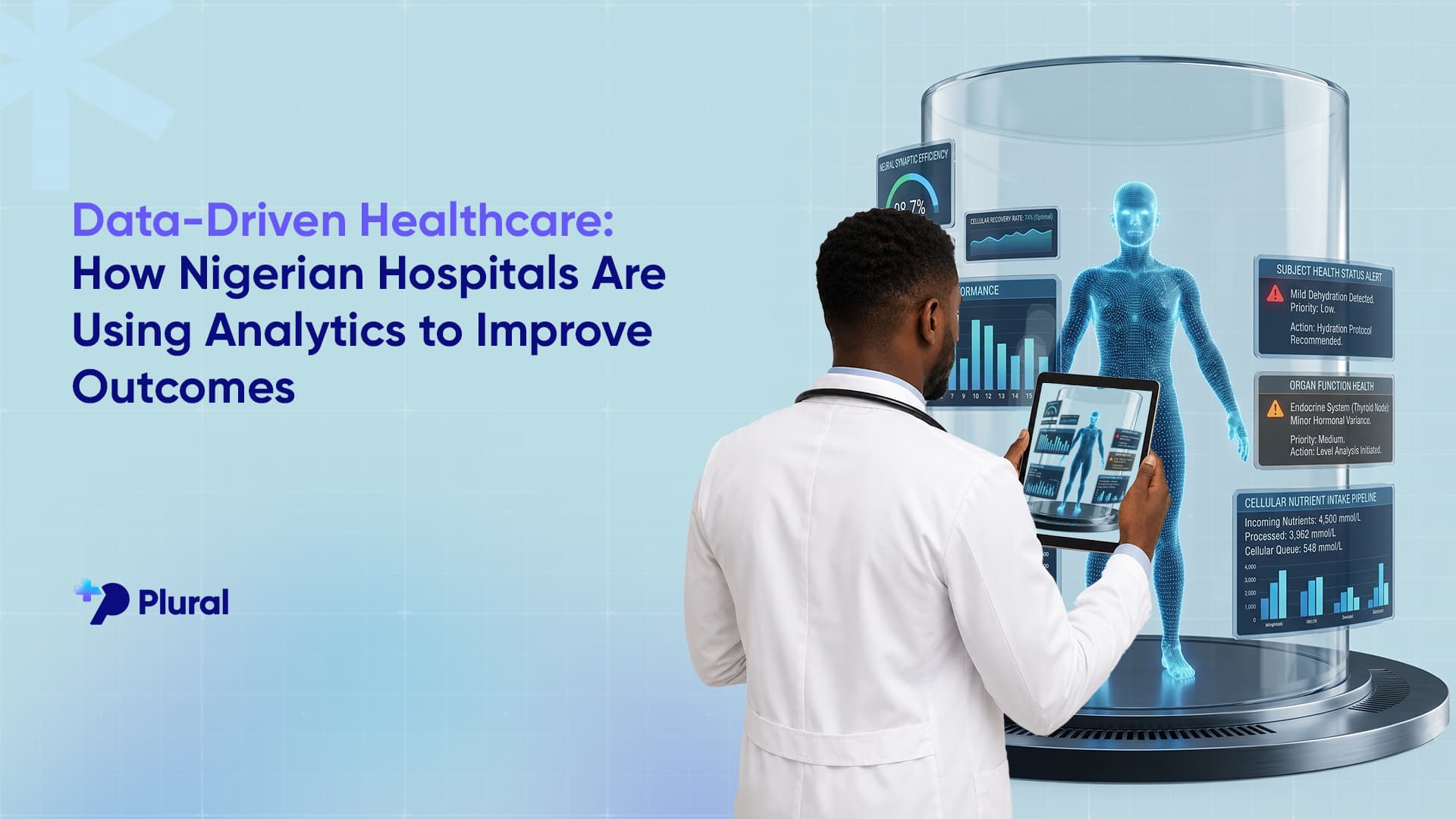
Data-Driven Healthcare: How Nigerian Hospitals Are Using Analytics to Improve Outcomes
Most hospital decisions in Nigeria are still made the same way they were thirty years ago: on experience, memory, and whoever raises the concern loudest in the morning meeting. That's not a criticism of the clinicians and administrators involved. It's just what happens when a hospital generates enormous amounts of information every day, and almost none of it gets reviewed after the fact.
Admission records, lab results, drug dispensing logs, billing entries, appointment schedules: hospitals produce all of this constantly. For decades, most of it sat in paper folders or in software systems that never spoke to each other. A patient's history lived in one file, their lab results in another, their bill in a third. As more hospitals move to electronic systems, that data is finally becoming usable instead of just stored, and a hospital that can see its own patterns clearly makes sharper decisions than one that can't.
What data-driven healthcare means
Data-driven healthcare is simply the practice of using information a hospital already collects to guide decisions, instead of relying purely on habit. In practice, that means tracking things like disease trends, bed occupancy, drug consumption, and revenue by department, and reviewing them on a schedule rather than only when something goes wrong. The shift is from reacting to problems to seeing them coming.
Why it matters here
Clinical outcomes. Tracking vitals and lab trends systematically lets a care team flag a deteriorating patient earlier, and lets chronic patients, diabetic and hypertensive cases especially, get followed up consistently instead of falling off the radar between visits.
Operational efficiency. Patient flow data exposes bottlenecks staff already feel but can't always pin down, like which clinic day produces the longest waits. Pharmacy data does the same for stock, catching a shortage weeks before it happens instead of when a patient needs a drug that isn't there.
Financial performance. Money leaks in places a ward walk-through won't reveal: a service rendered but never billed, a rejected insurance claim that never gets resubmitted, a department whose revenue has been quietly falling for two quarters. Data catches this. Instinct usually doesn't.
Strategic decisions. A second theatre, a new pediatrician, a satellite clinic across town: these are expensive calls that are often made on gut feeling. A hospital with a few years of admission data behind it can answer them with evidence instead.
What this looks like in practice
An administrator who starts reviewing weekly admissions notices emergency visits spike every Monday by roughly 30 percent, and adjusts the weekend handover instead of scrambling each week for extra hands. A pharmacy tracking consumption against stock sees a common antibiotic trending toward a shortage two weeks out, giving procurement time to reorder without an emergency markup. A finance team comparing departments side by side finds outpatient revenue has slid for two straight months, masked by a healthy inpatient number. None of this needs exotic technology. It needs clean data and the habit of actually looking at it.
It starts with good records
Analytics is only as good as the data behind it, and a hospital running on paper charts or disconnected tools has nothing consistent to analyze. Structured digital documentation is what makes patient data comparable and trackable in the first place. Platforms like Plural's NeoEHR build analytics dashboards directly into daily hospital workflow, turning admissions, billing, and drug dispensing data into something a clinical or administrative team can act on the same week, not a static report generated at month-end.
Where AI fits
AI is starting to show up in Nigerian healthcare conversations, and the interest is reasonable, though the technology is still early for most hospitals here. Where it works, it can flag a patient at risk based on subtle vital changes, forecast demand ahead of a seasonal pattern like malaria admissions before the rains, or support a diagnosis by cross-referencing a far larger dataset than any one doctor sees in a career. None of this replaces clinical judgment. It gives that judgment better information to work with, and the hospitals set up to benefit are the ones already disciplined about clean data today.
The real obstacles
Data quality is usually the first problem: incomplete or inconsistent records make any dashboard built on top of them unreliable. Paper-based workflows outside major cities remain a real barrier, and training is its own challenge, since a hospital can buy strong software and get no value from it if staff don't know how to read what it produces. Power and connectivity issues undermine even well-designed systems where a stable supply can't be assumed, and systems from different vendors often can't exchange data with each other at all. None of this is a reason to avoid the shift. It's a reason to move deliberately: clean documentation first, proper training before go-live, and systems built for Nigerian infrastructure rather than dropped in from elsewhere.
Looking ahead
Africa's digital health market is projected toward an estimated $11 billion opportunity in the coming years, and AI-powered EHR adoption is rising alongside it. That growth means more tools will reach Nigerian hospitals, not that every hospital will automatically benefit from them. The ones that will are the ones that build the habit of reviewing their own numbers continuously, not just when a report is due to a board.
Most hospitals in Nigeria aren't short on data. They're short on the habit of looking at what they already have. Before investing in anything new, it's worth asking a simpler question: how much of the information this hospital already collects actually gets reviewed, and by whom?
For hospitals ready to find out, NeoEHR's analytics tools turn the numbers a hospital already generates into insight a team can act on the same week it shows up.
Tags:
About Collins okeh
Contributing author at Plural Health, sharing insights on healthcare innovation and digital health solutions.