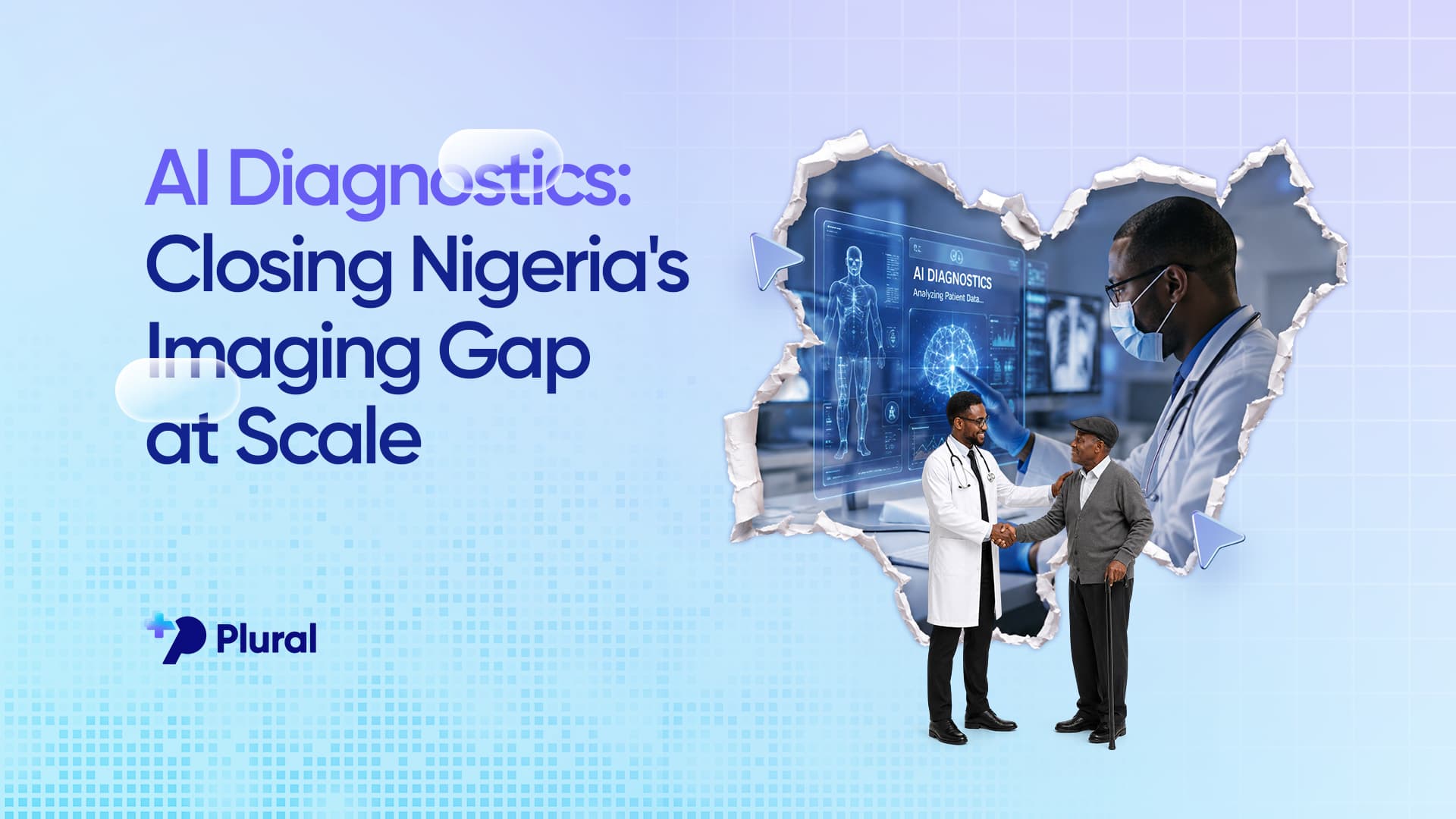
AI Diagnostics: Closing Nigeria's Imaging Gap at Scale
In Adamawa State, northeast Nigeria, the public health system runs on five functioning X-ray machines and two trained radiologists, for a population of more than 4.5 million. That is not an isolated gap. It is close to the national picture.
Nigeria has fewer than 300 practicing radiologists for a population that has crossed 220 million, roughly one for every 650,000 to 700,000 people. The international benchmark for adequate coverage is closer to 100 radiologists per million. Nigeria is running at a fraction of that, in a country where cancer, tuberculosis, stroke, and maternal complications all depend heavily on how fast a scan gets read.
Why the gap keeps widening
Radiology takes years of subspecialty training, and Nigeria loses radiologists to migration faster than it produces them. A resident who finishes a fellowship in Lagos often has a UK or Gulf offer within months. The specialists who remain are concentrated in Lagos, Abuja, and a handful of teaching hospitals, so a patient at a secondary hospital elsewhere can wait weeks for a scan to be read, not because a machine is broken, but because no one within reach is qualified to interpret it. Equipment and specialist salaries are also priced in a market where the naira has lost significant value against the dollar, so hospitals that do invest in imaging often can't staff it properly. None of these pressures are closing on their own.
What AI actually changes
AI-assisted diagnostics does not replace a radiologist. It extends how far one radiologist's judgment can reach. It flags which scans in a queue look urgent, so the critical case gets read first instead of wherever it lands in the file order. It applies the same detection threshold every time, which matters when fatigue affects human accuracy late in a long shift. And where no radiologist is available at all, it can produce a preliminary read that a remote specialist later confirms.
The proof is already in Nigeria
Between July and December 2022, a team ran 66 community screening camps across rural Gombe and Adamawa states, using battery-powered, ultra-portable X-ray units paired with AI software (qXR) to screen for tuberculosis. They screened 5,297 people, no electricity required, run by health workers with basic training.
Symptom screening alone, the traditional two-week cough check, caught just 40% of confirmed TB cases in the group. Broadening it to any symptom raised sensitivity to 91%, but meant testing 906 people. Using the AI's abnormality score instead caught 89% of confirmed cases while running fewer than half as many lab tests, saving close to $5,000 in cartridge costs from a single campaign. Combining a moderate AI score with any reported symptom caught every confirmed case in the study. Community acceptance was 100%, and local leaders asked for more camp days than were available.
Nigeria has since scaled the approach, deploying ultra-portable AI-enabled X-ray units across eight states. Rwanda has run a comparable model for years through its national TB programme, linking mobile X-ray units to a central image archive in Kigali for remote review. In both cases, AI didn't arrive as a finished product. It arrived inside a workflow already built to move a patient from scan to result to treatment, which is the part worth learning from.
Global investment is following the same logic. Research Nester puts the AI-in-diagnostics market at roughly $1.3 billion in 2024, headed toward close to $19 billion by 2037. A hospital with a digitized, well-governed imaging workflow today is positioning itself as a partner for that wave, not just a future buyer.
What hospitals should do now The starting point has almost nothing to do with buying AI software.
-
Digitize the imaging workflow first. An AI tool has nothing to plug into if scans are still printed on film.
-
Adopt interoperable systems. Records that connect a hospital's departments matter more than any single AI tool sitting on top.
-
Fix data discipline before the algorithm. Consistent labeling and structured reports improve diagnostic speed with or without AI.
-
Train clinicians on what AI is and isn't. A flagged scan is a prompt for review, not a diagnosis.
-
Set governance before deployment. Decide who reviews a flagged scan, and how disagreements get resolved, before the first pilot.
-
Build in data privacy from day one. The Nigeria Data Protection Act 2023 classifies secondary and tertiary hospitals as major data processors, with real registration and breach-reporting obligations that apply directly to imaging data.
-
Pilot one use case and measure it honestly, rather than rolling out broadly with no way to tell if it worked.
The choice in front of hospital leaders
Every one of those steps depends on an electronic health record system that connects a hospital's departments and gives clinicians one place to see a patient's full record, not five disconnected ones. That foundation, not the AI layer on top of it, is where Plural Health has focused its work through NeoEHR, because whichever AI vendor a hospital eventually chooses will need exactly that structure to work.
Nigeria's radiologist shortage will not close through training alone, and AI is not a substitute for that longer investment. But it is the tool available now that can extend the reach of the radiologists Nigeria already has, and the Gombe and Adamawa camps already show it works in the conditions Nigerian hospitals actually operate in. The hospitals that get their data and workflows ready today won't be scrambling to catch up when this becomes standard practice. They will be the ones it was built to work with from the start.
Tags:
About Collins okeh
Contributing author at Plural Health, sharing insights on healthcare innovation and digital health solutions.