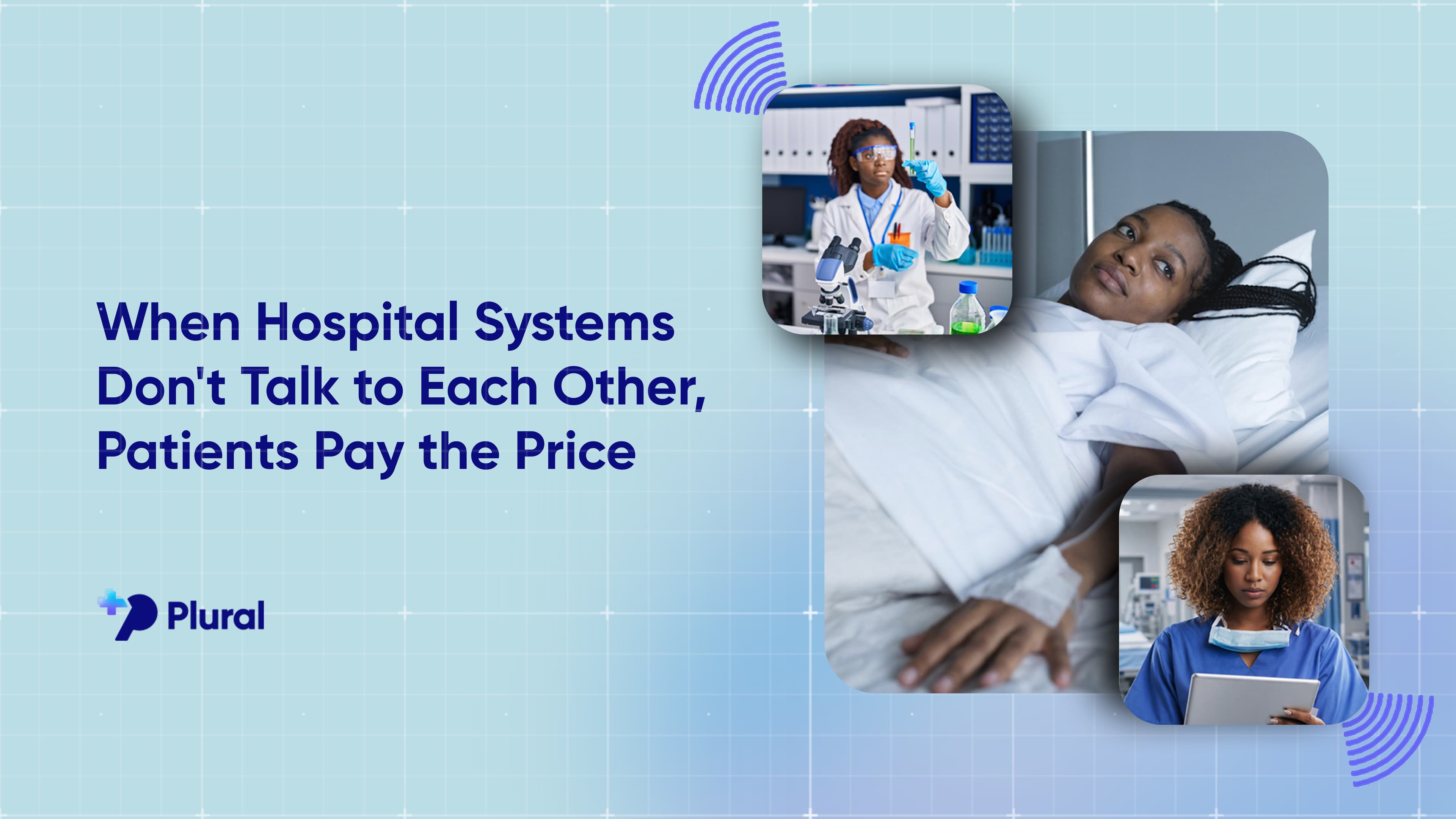
When Hospital Systems Don't Talk to Each Other, Patients Pay the Price
On a typical night shift in a Nigerian hospital, a significant portion of a nurse's time has nothing to do with nursing.
It goes toward tracking down lab results. Running prescriptions between departments. Repeating information during handovers that was never properly documented. This invisible coordination burden is one of the most overlooked sources of strain on an already stretched system, and it is entirely unnecessary.
What Does a Three-Hour Lab Result Actually Cost?
A patient comes in with suspected sepsis. The nurse collects the sample, walks it to the lab herself because the porter has gone home or was sent on an errand, and waits. She calls at 12:30 AM. Call again at 1:45 AM. At 2:10 AM, she walks back down and finds the printed result sitting on a desk, unsent.
Three hours gone, not because of incompetence but because nobody shared the same information.
Sepsis is time-sensitive. Those three hours are not a minor inefficiency; they are a clinical risk. And this kind of delay is not exceptional. It is routine. (Writing from experience)
The Pharmacy Runaround
A doctor prescribes post-op pain medication. It's out of stock, so the nurse goes back to the doctor. New prescription. New question from the pharmacist. The nurse becomes a messenger in a conversation that should be happening directly. This is an experience I truly cannot forget. The patient asks every twenty minutes when the medication is coming.
This is what happens when departments cannot see the same data: Clinical staff spend their shifts relaying information instead of delivering care. Research suggests nurses in under-resourced hospitals spend up to a third of their shifts on exactly this kind of non-clinical coordination.
Handover: Where Things Quietly Fall Apart
"Bed 3 - should be getting a result this morning."
"Bed 7 - doctor might change the fluids."
"Bed 9 - family wants to discuss discharge."
Should. Might. Wants to. The language of handover in paper-based systems is the language of uncertainty. The incoming nurse spends her first hour rebuilding the context that the outgoing shift already gathered. Poor handover communication is a documented contributor to medication errors and missed interventions, not a minor inconvenience.
In a connected system, handover looks different, not a verbal summary of approximations, but a documented timeline: what was done, when, what's pending, what's due. The incoming nurse doesn't rebuild; she continues care.
The Real Problem
This is not a skills crisis. Nigerian hospitals produce highly trained clinicians, people who go on to thrive in systems built for coordination. The problem is that skilled people have been working in workflows designed against them.
Integrated digital systems don't make hospitals perfect. Implementation is hard; training, infrastructure, cost, and institutional buy-in are all real barriers. But the directional evidence is consistent: when clinical departments share real-time patient information, the coordination burden drops, and so does the margin for error.
The inefficiency in Nigerian healthcare is not inevitable. It is infrastructural, and that means it is fixable.
The Solution
The first time I used a truly connected system, it didn’t feel like some big digital transformation. It felt like relief.
With NeoEHR by Plural Health, the difference shows up in the small, everyday moments that used to slow everything down. A lab test is ordered, and you can see when the sample is received, when it’s being processed, and when results are ready without making a single call. Prescriptions move straight to the pharmacy, and any clarification happens within the system, not through a chain of people. During handovers, you’re not piecing together stories from memory; the full patient journey is already there, clear and time-stamped.
It’s not about perfection. There are still busy days, still pressure, still real-world constraints. But the unnecessary friction disappears. You’re no longer spending your shift chasing information or fixing communication gaps. The system carries that weight.
And once you’ve worked that way, it becomes very hard to go back.
If this is the kind of clarity your hospital needs, it’s worth seeing it in action. Book a demo with Plural and experience connected care firsthand as I did.
Tags:
About Okeh Collins
Contributing author at Plural Health, sharing insights on healthcare innovation and digital health solutions.