The Doctor Shortage Crisis and How AI Is Filling the Gap
What happens when there simply aren't enough doctors to meet the needs of millions of patients?
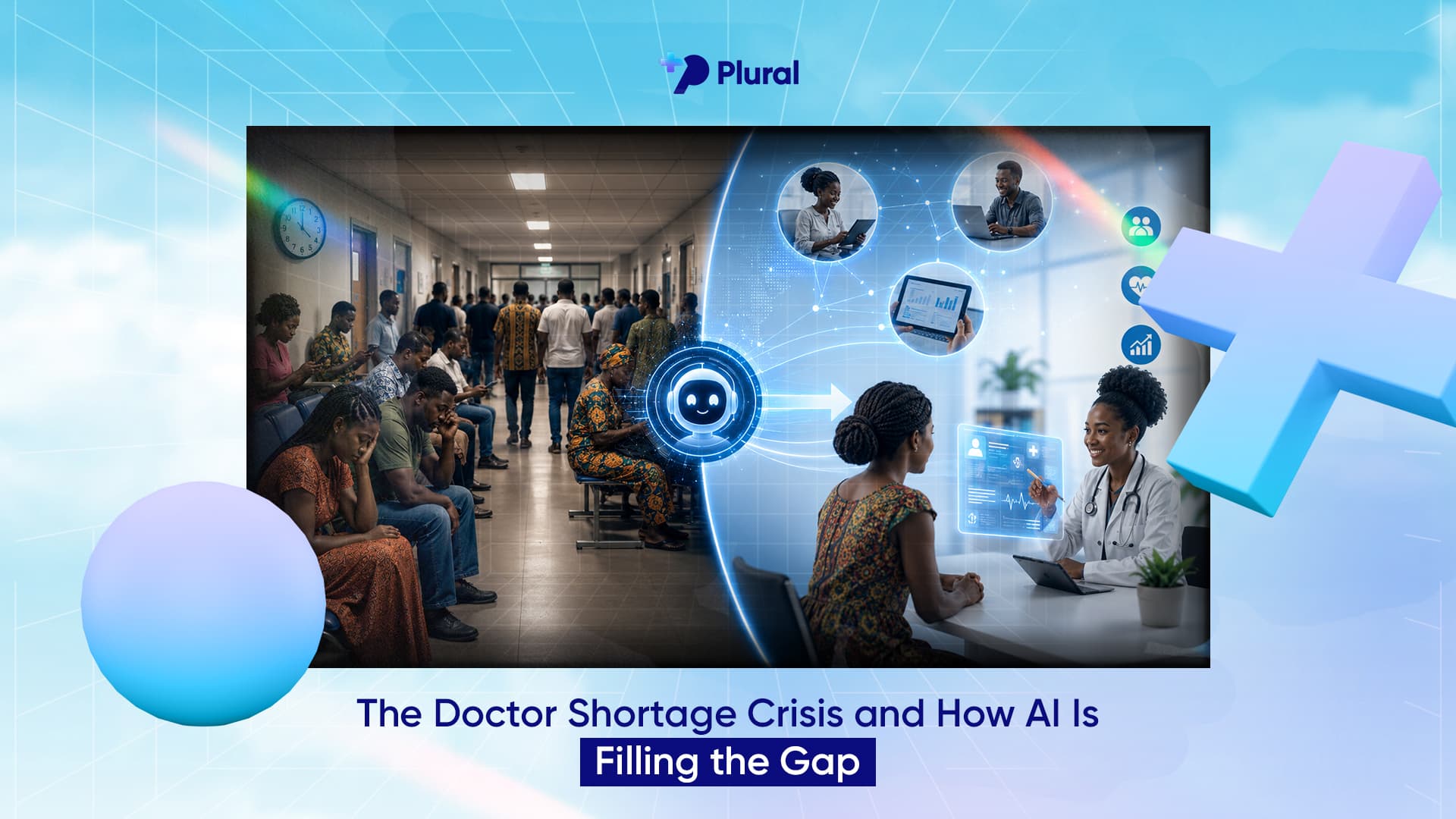
This is not a thought experiment. It plays out daily at a general hospital in Warri, where a single consultant works through a queue that began forming before dawn. It is a primary health centre in rural Kebbi, staffed by one health worker for a catchment of 40,000 people. It is a tertiary hospital in Lagos where a lone radiologist reads scans for three other facilities, none of which can justify hiring their own.
Nigeria has roughly 38 doctors for every 100,000 people. The WHO's recommended minimum is 166. Across Africa, the picture isn't much better. Most countries fall well short of the 4.45 health workers per 1,000 population, which the WHO considers the floor for basic universal coverage. Only a handful of nations, mostly small island states, currently meet it.
These aren't abstract numbers. They translate directly into how long a patient waits, whether a complication gets caught in time, and whether a clinician has the bandwidth to think through a hard case instead of just moving to the next one.
A Problem With Several Moving Parts
Nigeria's population is growing faster than its capacity to train and retain doctors, so the gap widens every year. Brain drain compounds it: roughly half of Nigeria's licensed doctors now practice abroad, and over 700 relocated to the UK in just five months between late 2021 and mid-2022, often the most recently and rigorously trained, not the ones the system could most afford to lose. Burnout pushes out many of those who stay; surveys of Nigerian healthcare workers consistently find a large majority have seriously considered leaving, with burnout among the strongest predictors.
Patients feel all of this directly: rushed consultations, specialist care that exists in theory but isn't reachable outside two or three cities, rural patients trekking long distances for care that should be local.
Why More Doctors Alone Won't Close the Gap
Training a Nigerian doctor takes roughly a decade end-to-end: medical school, housemanship, residency, and that's before factoring in how many leave the moment their license clears. Meanwhile, demand keeps shifting: chronic conditions like hypertension and diabetes now sit alongside the infectious disease burden the system was built around, and managing a hypertensive patient for twenty years takes far more touchpoints than treating an acute infection ever did.
Even in the best case, where Nigeria trains more doctors and keeps more of them, the math doesn't close fast enough. This is structural, not a recruitment problem. The useful question isn't "how do we get more clinicians," it's "how do we get more capacity out of the clinicians we already have." That's where AI actually fits.
Where AI Is Expanding Clinical Capacity
The honest version of this story isn't AI doing medicine. It's AI handling the parts of a clinical day that aren't medicine, so more of the day is left for the parts that are.
Documentation: Doctors often spend more time writing notes than seeing patients. Tools that generate structured notes from a consultation or dictation give that time back, and it adds up fast across a hospital's weekly consultation volume.
Triage: Not every patient needs a doctor's immediate attention, but someone has to determine that. AI-supported triage helps front-line staff sort by acuity faster, so clinical attention goes where it's needed first.
Diagnostic decision support: Tools that flag likely differentials or catch a drug interaction don't replace judgment; they give a second pair of eyes to a clinician fourteen hours into a shift.
Follow-up and population health: Automated reminders and adherence check-ins via SMS or WhatsApp handle the repetitive side of chronic disease management. Predictive analytics on existing patient data can help hospitals anticipate seasonal surges instead of reacting once the wards are full.
The thread running through all of this is capacity, not replacement. None of it requires a machine to make a judgment that carries legal or ethical weight; it requires a machine to clear the surrounding work so a human can make that judgment with more time and better information.
AI Is Not Replacing Doctors
This fear is reasonable and worth addressing directly. An algorithm can flag a pattern. It cannot sit with a frightened patient and explain what a diagnosis means for their life, or read the hesitation in their voice when they say they're "managing fine" on medication they've actually stopped taking. Clinical accountability also stays exactly where it belongs with a licensed professional, not a piece of software.
It's also worth being honest about limits. African clinical data is often sparse or not yet digitized, so tools trained elsewhere don't always transfer cleanly here, and unreliable power or connectivity still constrains what's deployable in many facilities. None of that is a reason to dismiss the technology; it's a reason to be skeptical of anyone selling it as a complete solution rather than a tool that works best with a clinician firmly in the loop.
What Healthcare Leaders Should Be Doing Now
Hospital owners and CMDs should start with documentation of administrative bottlenecks, scheduling, follow-up before anything clinically sensitive, and pilot in one department before going hospital-wide. Policymakers should treat the regulatory gap as the real bottleneck: clear standards on data protection, liability, and validation would do more for safe adoption than another funding programme, alongside continued investment in basic digital infrastructure. Investors will find more durable opportunities in tools that make existing clinical workforces more productive than in tools positioned to replace them; the latter struggle against both regulation and trust.
Conclusion
Nigeria can't just train its way out of such a large workforce deficit within ten years; that's simply not how quickly doctors are made or how fast demand is increasing. What is achievable, however, is enhancing the skills of the clinicians already in the system so they can be even more effective at what only they can do.
The future of healthcare in Africa won't be built by choosing between clinicians and technology. It will be built by empowering clinicians with technology, which is the work Plural Health is part of.
Explore Plural Health's AI-powered clinical tools and see how healthcare organizations can expand capacity without expanding burnout.
Tags:
About Okeh Collins
Contributing author at Plural Health, sharing insights on healthcare innovation and digital health solutions.